Osmanthus heterophyllus/NJ
'"`UNIQ--btaxobox-00000000-QINU`"'
Common Name: Holly osmanthus, Holly olive, False holly
Family Name: Oleaceae
Species Code: OSHE
Native Range: Japan and Taiwan
NJ Status: Emerging Stage 0 – Absent or very rare. It is on our "Watch List" because it may become threatening to native communities.
General Description
• Large evergreen slow-growing shrub reaching 8 to 15 feet tall and 8 to 10 feet wide
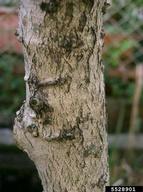
• Bark is light brown with small, raised lenticels
Leaves
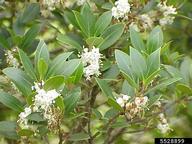
• Opposite, simple, elliptic or ovate
• 1 to 2 ½ inches long
• Leathery, lustrous dark green above, yellow-green beneath with reticulate venation
• The margin is entire or may have one to four large spine-tipped teeth on each side, resembling a holly leaf
• Spiny leaves predominate on small, young plants (an adaptation to deter browsing animals), while entire leaves predominate on larger mature plants out of the reach of animals
• The scientific name “heterophyllus” means different leaves and refers to the variation in leaf shape between young and mature plants
Flowers
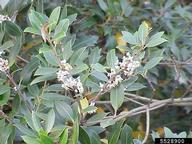
• Small white fragrant flowers bloom from September to October
• Dioecious and appear in the leaf axils
• Strongly fragrant, with four petals,1/4" wide, in clusters of 4 to 5
Fruit
• Ovoid dark purple drupe
• 3/8" to 1/2" long
Habitat
• Prefers fertile, moist, well-drained, acid soil, but tolerates higher pH soils
• Prefers full to part sun, and can grow in semi-shade (light woodland)
• Tolerates strong winds but not maritime exposure
Commercially Available
Yes
Look-alikes
• Holly (Ilex spp.)
• Osmanthus have opposite leaves, while holly have alternate leaves
Control Recommendations
Foliar Spray: FS-2
• Glyphosate 3.00%
• Please see our Herbicide Use Suggestions and Mixing Guide for more information
Basal Bark: BB-1
• Triclopyr Ester 25% OR Pathfinder II ready-to-use mixture
• Please see our Herbicide Use Suggestions and Mixing Guide for more information
Cut Stump: CS-1
• Glyphosate 50%
• Please see our Herbicide Use Suggestions and Mixing Guide for more information
List of Resources
• National Park Service
• University of Delaware Botanic Gardens
Images from Bugwood.org