HPIPM:Sunflower Stem Weevil
Author: Frank B. Peairs[1]

Field Biology and Identification
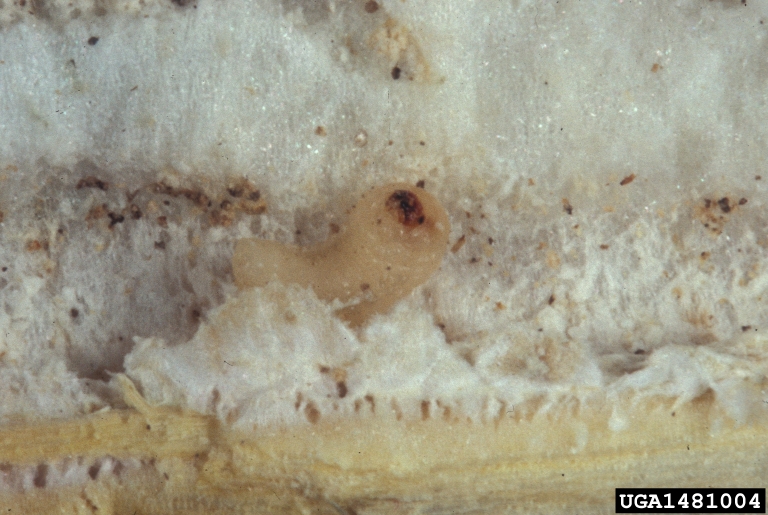
Adults are four to five millimeters (about 3/16 inch) in length and grayish‑brown with varying shaped white spots on the wing covers and thorax. Mature larvae are five to six millimeters (0.2 inches) long with a creamy white body and a small brown head capsule. Normally, larvae appear C‑shaped when found in sunflower stalk tissue. Adults can be found on plants in June and July feeding on the epidermal tissue of the sunflower foliage. This feeding does not affect plant vigor. Eggs are deposited individually in the epidermal tissue of the stem. A single female may deposit up to 20 eggs per plant during a two‑week period. Newly hatched larvae feed on leaf tissue, but latter stages move into the stalks from July to late September. A chamber is formed by mature larvae (fourth instar) near the base of the stalk where they remain all winter. The presence of larval chambers can weaken the stalk, causing infested plants to lodge as they dry down. Pupation occurs from May to June of the next year.
Plant Response and Damage
Adult feeding injury is considered insignificant. However, since the pathogen Phoma macdonaldii Boerma has been isolated from adults they are highly suspected of vectoring Phoma black stem disease in sunflower fields. Stem weevil larvae can cause serious stalk breakage. Considerably weakening of the stem can occur when larval infestations reach 25 or more per stalk. Breakage is most likely to occur when plants are under drought stress and/or during periods of high wind. Breakage due to stem weevil typically occurs at or slightly above the soil line.
Management Approaches
Chemical Control
Scouting should start at 600 growing degree days (base 43◦F, starting January 1. When scouting, sample sites should be 75 to 100 feet from the edge of the field. Use an X‑pattern and examine five plants per sampling site for a total of 25 plants at the eight to 14 leaf stage (developmental stages V-8 to R-1) in late June to early July. Determine the average number of adult weevils per plant. Keep in mind that the adults are difficult to see, and they have the habit of dropping to the ground and "playing dead" when disturbed. Insecticide applications are made to prevent the adults from depositing their eggs in the stalk. A treatment is probably justified when one or more adults are found per three plants from stage V-8 through R-1.
Product list for Sunflower Stem Weevil:
| Pesticide | Product/Acre (Fl oz. or oz. product) | Preharvest Interval, remarks |
|---|---|---|
| beta-cyfluthrinR,1,2 | See labels | 30 days. 12 hour REI. Maximum 8.4 fl oz/acre/season. Extremely Hazardous to Bees! |
| chlorpyrifosR,1,2 | See labels | 42 days. 24 hour REI. Do not graze. Extremely Hazardous to Bees! |
| chlorpyrifos + gamma cyhalothrinR,1,2 | See labels | 45 days. Do not graze. 24 hour REI. Extremely Hazardous to Bees! See labels for additional restrictions for individual active ingredients. |
| Cobalt AdvancedR,1 | 16 - 38 | 45 days. Do not graze. 24 hour REI. Extremely Hazardous to Bees! Maximum 114 fl oz product/acre/season. See labels for additional restrictions for individual active ingredients. |
| cyfluthrinR,1,2 | See labels | 30 days. 12 hour REI. See labels. Extremely Hazardous to Bees! |
| deltamethrin R,1,2 | See labels | 21 days. Do not graze or feed treated foliage. 12 hour REI. Do not apply more than 0.045 lb ai/acre/crop. Extremely Hazardous to Bees! |
| esfenvalerateR,1,2 | See labels | 28 days. 12 hour REI. Do not apply more than 0.2 lb ai/acre/crop. Extremely Hazardous to Bees! |
| gamma cyhalothrinR,1,2 | See labels | 45 days. 24 hour REI. Extremely Hazardous to Bees! |
| lambda cyhalothrinR,1,2 | See labels | 45 days. 24 hour REI. Extremely Hazardous to Bees! |
| BesiegeR | 6 - 10 | 45 days. 24 hour REI. Not more than 31 fl oz/acre/season. |
| zeta cypermethrinR,1,2 | see labels | 30 days. Do not apply more than 0.125 lb ai/acre/crop. Extremely Hazardous to Bees! See label for at-plant application. |
| StallionR,1 | 5.0 - 11.75 | 42 days. 24 hr REI. Extremely Hazardous to Bees! No more than 11.75 oz per application, 35.25 oz per season. See labels for additional restrictions for individual active ingredients. |
| RRestricted use pesticide. 1Labeled for chemigation. 2Generic active ingredient, several formulations. | ||
The information herein is supplied with the understanding that no discrimination is intended and that listing of commercial products, necessary to this guide, implies no endorsement by the authors or the Extension Services of Nebraska, Colorado, Wyoming or Montana. Criticism of products or equipment not listed is neither implied nor intended. Due to constantly changing labels, laws and regulations, the Extension Services can assume no liability for the suggested use of chemicals contained herein. Pesticides must be applied legally complying with all label directions and precautions on the pesticide container and any supplemental labeling and rules of state and federal pesticide regulatory agencies. State rules and regulations and special pesticide use allowances may vary from state to state: contact your State Department of Agriculture for the rules, regulations and allowances applicable in your state and locality.
