HPIPM:Sunflower Beetle
Author: Frank B. Peairs[1]
Field Biology and Identification
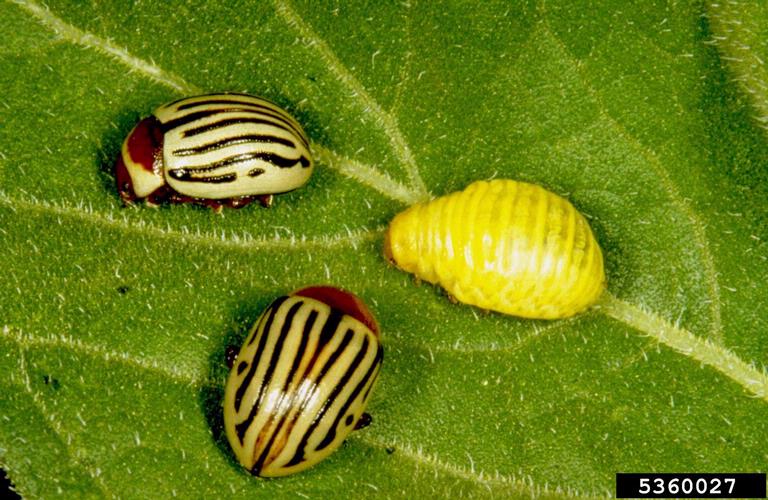
Adult sunflower beetles, Zygogramma exclamationis (Fabricius), are about six to eight millimeters (1/4 to 1 1/2 inches) in length and have a reddish‑brown head, cream-colored back with three dark reddish‑brown stripes on each wing cover. Adults resemble adult Colorado potato beetles, however, sunflower beetles do not feed on potatoes and Colorado potato beetles do not feed on sunflowers. Larvae are yellowish‑green, and hump‑backed in appearance.
The sunflower beetle undergoes a single generation per year. The overwintering adults become active in the region in June and July to mate and deposit eggs on stems and leaves. Eggs are deposited on stems and undersides of leaves. A single female has been estimated to deposit 200 eggs. Larvae may be found soon afterwards and remain in the field for up to six weeks. Mature larvae enter the soil where they pupate in earthen cells. After ten to fourteen days, a new generation of adults emerges and feeds for a short time before reentering the soil where they overwinter.
Plant Response and Damage
Both adults and larvae are defoliators, but larvae are considered to be more economically significant. Adult sunflower beetle damage begins early in the season, defoliating seedlings. The larvae cause damage by chewing holes in the leaves. Normally, most of their feeding occurs at night. During the daytime they typically rest in the terminal growth area.
Management Approaches
Chemical Control
When scouting, sample sites should be 75 to 100 feet from the edge of the field. Use an X‑pattern counting adults and/or larvae on 20 plants per sampling site for a total of 100 plants. Determine the average number of adults and/or larvae per plant. To determine percent defoliation of plants, examine 100 plants per sampling site for a total of 500 plants.
Adults attack early in the season, defoliating seedlings. One adult per plant is considered to be economic. Later the larval stage feeds on larger plants. Fifteen larvae per plant or 25 percent defoliation would justify an insecticide application. Alternatively, use the table below to determine the potential yield loss from the observed level of defoliation
Estimated % yield reduction from sunflower defoliation occurring at various growth stages (From North Dakota State University Extension Bulletin 25)
| 10 | 20 | 30 | 40 | 50 | 60 | 70 | 80 | 90 | 100 | |
|---|---|---|---|---|---|---|---|---|---|---|
| Growth Stage | ||||||||||
| V-4 to V-5 | 0 | 1 | 2 | 2 | 4 | 4 | 5 | 9 | 14 | 21 |
| V-9 to V-11 | 0 | 2 | 3 | 4 | 5 | 5 | 7 | 11 | 17 | 24 |
| R-1 | 2 | 4 | 6 | 6 | 7 | 9 | 16 | 24 | 34 | 47 |
| R-3 | 2 | 8 | 15 | 19 | 24 | 32 | 44 | 59 | 78 | 99 |
| R-5 | 1 | 3 | 7 | 10 | 16 | 25 | 37 | 49 | 67 | 90 |
| R-7 | 0 | 1 | 3 | 7 | 10 | 13 | 16 | 18 | 20 | 22 |
| R-8 | 0 | 1 | 2 | 3 | 5 | 7 | 8 | 9 | 10 | 11 |
Product list for Sunflower Beetle:
| Pesticide | Product/Acre (Fl oz. or oz. product) | Preharvest Interval, remarks |
|---|---|---|
| beta-cyfluthrinR,1 | See labels | 30 days. 12 hour REI. See labels. Extremely Hazardous to Bees! |
| carbaryl1,2 | See labels | 60 days seed, 30 days grazing or harvest for forage. 12 hour REI. Extremely Hazardous to Bees! |
| chlorpyrifosR,1,2 | See labels | 42 days. 24 hour REI. Do not graze. Extremely Hazardous to Bees! |
| chlorpyrifos + gamma cyhalothrinR,1,2 | See labels | 45 days. Do not graze. 24 hour REI. Extremely Hazardous to Bees! See labels for additional restrictions for individual active ingredients. |
| Cobalt AdvancedR,1 | 16 - 38 | 45 days. Do not graze. 24 hour REI. Extremely Hazardous to Bees! Maximum 114 fl oz product/acre/season. See labels for additional restrictions for individual active ingredients. |
| cyfluthrinR,1,2 | See labels | 30 days. 12 hour REI. See labels. Extremely Hazardous to Bees! |
| deltamethrinR,1,2 | See labels | 21 days. Do not graze or feed treated foliage. 12 hour REI. Do not apply more than 0.045 lb ai/acre/crop. Extremely Hazardous to Bees! |
| esfenvalerateR,1,2 | See labels | 28 days. Do not apply more than 0.2 lb ai/acre/crop. 12 hour REI. Extremely Hazardous to Bees! |
| gamma cyhalothrinR,1,2 | See labels | 45 days. 24 hour REI. Extremely Hazardous to Bees! |
| lambda cyhalothrinR,1,2 | See labels | 45 days. 24 hour REI. Extremely Hazardous to Bees! |
| BesiegeR | 5 - 8 | 45 days. 24 hour REI. Not more than 31 fl oz/acre/season. |
| zeta cypermethrinR,1,2 | see labels | 30 days. Do not apply more than 0.125 lb ai/acre/crop. Extremely Hazardous to Bees! See label for at-plant application. |
| StallionR,1 | 5.0 - 11.75 | 42 days. 24 hr REI. Extremely Hazardous to Bees! No more than 11.75 oz per application, 35.25 oz per season. See labels for additional restrictions for individual active ingredients. |
| RRestricted use pesticide. 1Labeled for chemigation. 2Generic active ingredient, several formulations. | ||
The information herein is supplied with the understanding that no discrimination is intended and that listing of commercial products, necessary to this guide, implies no endorsement by the authors or the Extension Services of Nebraska, Colorado, Wyoming or Montana. Criticism of products or equipment not listed is neither implied nor intended. Due to constantly changing labels, laws and regulations, the Extension Services can assume no liability for the suggested use of chemicals contained herein. Pesticides must be applied legally complying with all label directions and precautions on the pesticide container and any supplemental labeling and rules of state and federal pesticide regulatory agencies. State rules and regulations and special pesticide use allowances may vary from state to state: contact your State Department of Agriculture for the rules, regulations and allowances applicable in your state and locality.
