HPIPM:Spider Mites Sorghum
Authors: John B. Campbell & Frank B. Peairs[1]
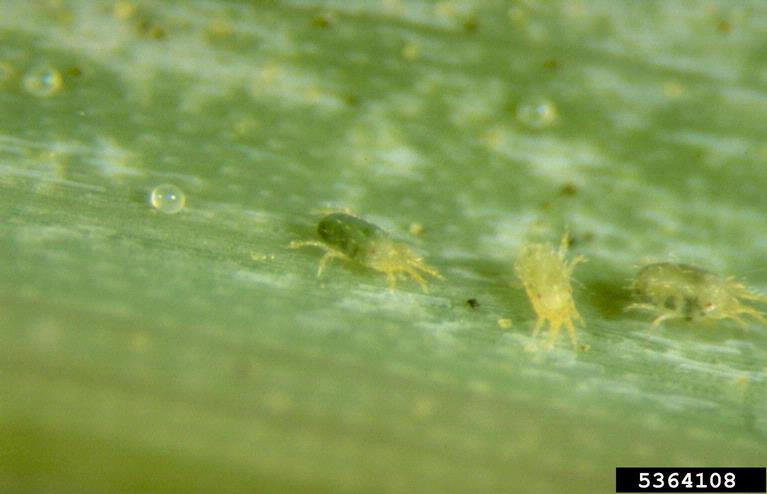

Spider mites may become a problem if hot, dry weather persists for any length of time. However, the problem is more common in Oklahoma and Texas than in Colorado, Nebraska or Wyoming. The mites start on the bottoms of the lower leaves and if not curtailed, may move rapidly up the plant, killing the leaves as the colonies increase in number.
Identification (and life cycle/seasonal history)
Mites that are of economic importance consist of two species; the Banks grass mite, Oligonychus pratensis (Banks), and the twospotted spider mite, Tetranychus urticae Koch. It is important to identify the species causing the damage in order to make an insecticide selection. Twospotted mite is much more resistant to pesticides than is Banks grass mite. Twospotted mite has pigmentation spots on the back caused by food particles that accumulate in the gut along the side of the body in two distinct spots and they do not extend over halfway along the body. The pigment spots on Banks grass mite are found on each side of the body along the edges and extend from the front to the back.
Management Approaches
Cultural Control
Grassy weeds harbor mites overwinter and should be eliminated two or three weeks prior to planting the sorghum. If the sorghum is following wheat, volunteer wheat should be destroyed in the fall. Good production practices, in general, should be followed to assure a good, healthy sorghum stand.
Chemical Control
During hot, dry weather, field scouting for mites should be done weekly. Monitor predicted weather conditions if mites are present and hot, dry weather continues; in all probability, mite numbers will increase. Determine which mite species is present. If both species are present, assume the twospotted mite will be the dominant species in time. Field scouts should survey not only the mites, but the major predators such as predatory mites, Stethorus lady beetles, sixspotted thrips and minute pirate bugs. If enough of these are present, they may keep the mites in check. Scouts may wish to flag some plants and return to them the following week to determine if mites are increasing in number.
If mites have reached numbers where large colonies on the bottom leaves and weather forecasts indicate continued hot, dry weather, it is probably advisable to treat.
Due to constantly changing labels, laws and regulations, the sponsors of this web site assume no liability for the suggested use of any chemicals noted in the management section. Contact your local pest management personnel for current information on labeled pesticides that can be used for the intended plant disease, insect pest or weed.
