HPIPM:Red and Gray Sunflower Weevils
Author: Frank B. Peairs[1]
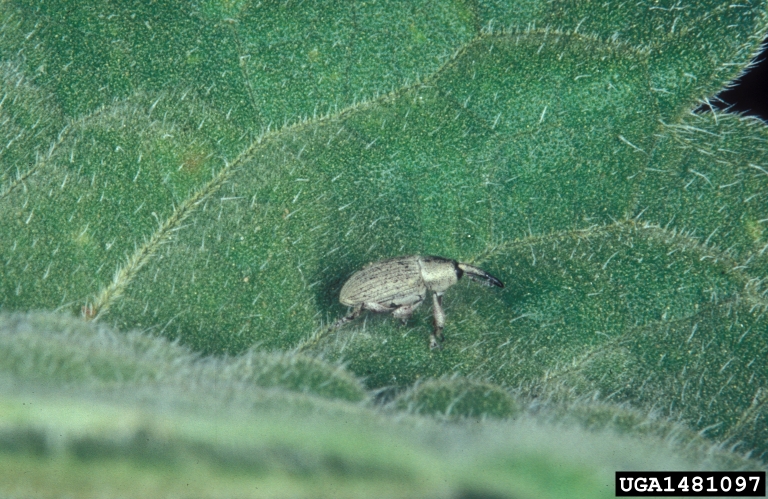


Field Biology and Identification
Red sunflower weevil adults, Smicronyx fulvus LeConte, are 2.5 to three millimeters (1/10 to 1/8 inch) in length and reddish‑brown in color with long snouts. Adult gray sunflower weevils, Smicronyx sordidus LeConte, are larger than red sunflower weevils and gray in coloration. Larvae are small, cream‑colored, legless and C‑shaped in appearance. Females usually lay a single egg directly into the developing seed. Egg laying begins at the outer edge of the head and progresses inward following seed development. Larvae feed on the inner meat of the seed. After larval feeding stops, in August to early October, they cut an exit hole in the seed and drop to the ground. The larvae overwinter in the soil at a depth of about six inches. Pupation occurs in June, lasting eight to 10 days. Adults may be found from June to September. There is a single generation per year.
Plant Response and Damage
Larvae feed on the inner meat of the seed. Some seeds may be totally consumed, however most seeds are only partially fed upon. Larvae emerging in storage will die without causing further damage to the seeds, however their bodies will remain in the bin.
Management Approaches
Cultural Control
If seed weevil infestations are encountered late in the year, harvest may be delayed to prevent weevil larvae leaving the seed from going into storage.
Chemical Control
Applications are made to prevent adults from laying their eggs. Use the information below to determine economic thresholds for red sunflower weevil on oilseed sunflower, applying treatments when about 30 percent of the plants have reached the R 5.1 stage (Scouting and threshold information taken from taken from Mcbride, D.K., G. J. Brewer, and L. D. Charlet. 1992. Sunflower Seed Weevils. North Dakota State University Cooperative Extension Bulletin E‑817 and the 1997 version of the same publication authored by C. Peng, G. Bewer, L. Charlet, and P. Glogoza). Confection sunflower should be treated to avoid quality penalties if less than 10 to 15 percent of the plants have reached R 5.1 and one or more red sunflower seed weevil can be found per head. The economic threshold for gray sunflower seed weevil is poorly defined and it is unlikely that treatments for this weevil species can be justified in either type of sunflower. If a treatment for gray sunflower seed weevil is needed, it should be applied when 10 to 15 percent of the plants have reached the R 4 stage.
Scouting for red sunflower seed weevil can be difficult because of its distribution in the field and because of its habit of hiding in the heads. Start scouting when the yellow ray petals are first visible and stop when the majority of the plants in the field have passed 70 percent pollen shed (R 5.7), or when the action threshold has been exceeded. Avoid taking seed weevil counts from plants in field margins as they tend to congregate in these areas and counts will not be representative of the entire field. Red sunflower seed weevils can be dislodged from the head for counting by spraying the head with an aerosol containing the insect repellent deet. This will flush the insects from their hiding places, allowing them to be counted easily. Count five sets of five plants, distributed across the field in an X‑pattern. If the insect repellent method is used, counts will need to be converted to estimated actual numbers using Table 1 before comparing them to calculated economic thresholds.
Table 1. Conversion of red sunflower seed weevil counts using deet repellent to estimated weevils per plant.
| Field Count | Converted Count |
|---|---|
| 1 | 1 |
| 2 | 3 |
| 3 | 4 |
| 4 | 6 |
| 5 | 7 |
| 6 | 11 |
| 7 | 12 |
| 8 | 14 |
| 9 | 16 |
| 10 | 18 |
| 11 | 20 |
| 12 | 21 |
| 13 | 23 |
| 14 | 25 |
| 15 | 27 |
| 16 | 29 |
| 17 | 31 |
| 18 | 33 |
| 19 | 35 |
| 20 | 37 |
| 25 | 46 |
| 30 | 56 |
| 35 | 65 |
| 40 | 75 |
Consider treating for red sunflower seed weevil in oilseed sunflower when counts exceed the economic threshold level in Table 2 for your plant population, control costs and expected market price. The thresholds in this table represent average regional growing conditions. Additional thresholds can be calculated for conditions not covered in the table using the following formula:
| Economic threshold (weevils per head)= | |
| (Market price x 21.5)(0.000022 x Plant population + 0.18) |
Table 2. Economic thresholds for Red Sunflower Seed Weevil on oilseed sunflower at
different plant populations, treatment costs and market prices.
| 12,000 | 14,000 | 16,000 | 18,000 | 20,000 | ||
|---|---|---|---|---|---|---|
| $8.00 | $0.08 | 10 | 10 | 9 | 8 | 8 |
| $0.10 | 8 | 8 | 7 | 6 | 6 | |
| $0.12 | 7 | 6 | 6 | 5 | 5 | |
| $10.00 | $0.08 | 13 | 12 | 11 | 10 | 9 |
| $0.10 | 10 | 10 | 9 | 8 | 8 | |
| $0.12 | 9 | 8 | 7 | 7 | 6 | |
| $12.00 | $0.08 | 16 | 14 | 13 | 12 | 11 |
| $0.10 | 13 | 11 | 10 | 10 | 9 | |
| $0.12 | 10 | 10 | 9 | 8 | 8 | |
Product list for Red and Gray Sunflower Seed Weevils:
| Pesticide | Product/Acre (Fl oz. or oz. product) | Preharvest Interval, remarks |
|---|---|---|
| beta-cyfluthrinR,1,2 | 2.0 - 2.8 | 30 days. 12 hour REI. See labels. Extremely Hazardous to Bees! |
| chlorpyrifosR,1,2 | See labels | 42 days. 24 hour REI. Do not graze. Extremely Hazardous to Bees! |
| chlorpyrifos + gamma cyhalothrinR,1,2 | See labels | 45 days. Do not graze. 24 hour REI. Extremely Hazardous to Bees! See labels for additional restrictions for individual active ingredients. |
| Cobalt AdvancedR,1 | 16 - 38 | 45 days. Do not graze. 24 hour REI. Extremely Hazardous to Bees! Maximum 114 fl oz product/acre/season. See labels for additional restrictions for individual active ingredients. |
| cyfluthrinR,1,2 | See labels | 30 days. 12 hour REI. See labels. Extremely Hazardous to Bees! |
| deltamethrinR,1,2 | See labels | 21 days. Do not graze or feed treated foliage. 12 hour REI. Do not apply more than 0.045 lb ai/acre/crop. Extremely Hazardous to Bees! |
| esfenvalerateR,1,2 | See labels | 28 days. Do not apply more than 0.2 lb ai/acre/crop. 12 hour REI. Extremely Hazardous to Bees! |
| gamma cyhalothrinR,1,2 | See labels | 45 days. 24 hour REI. Extremely Hazardous to Bees! |
| lambda cyhalothrinR,1,2 | See labels | 45 days. 24 hour REI. Extremely Hazardous to Bees! |
| BesiegeR | 6 - 10 | 45 days. 24 hour REI. Not more than 31 fl oz/acre/season. |
| zeta cypermethrinR,1,2 | see labels | 30 days. Do not apply more than 0.125 lb ai/acre/crop. Extremely Hazardous to Bees! See label for at-plant application. |
| StallionR,1 | 5.0 - 11.75 | 42 days. 24 hr REI. Extremely Hazardous to Bees! No more than 11.75 oz per application, 35.25 oz per season. See labels for additional restrictions for individual active ingredients. |
| RRestricted use pesticide. 1Labeled for chemigation. 2Generic active ingredient, several formulations. | ||
The information herein is supplied with the understanding that no discrimination is intended and that listing of commercial products, necessary to this guide, implies no endorsement by the authors or the Extension Services of Nebraska, Colorado, Wyoming or Montana. Criticism of products or equipment not listed is neither implied nor intended. Due to constantly changing labels, laws and regulations, the Extension Services can assume no liability for the suggested use of chemicals contained herein. Pesticides must be applied legally complying with all label directions and precautions on the pesticide container and any supplemental labeling and rules of state and federal pesticide regulatory agencies. State rules and regulations and special pesticide use allowances may vary from state to state: contact your State Department of Agriculture for the rules, regulations and allowances applicable in your state and locality.
