HPIPM:Painted Lady Butterfly
Author: Frank B. Peairs[1]

Field Biology and Identification
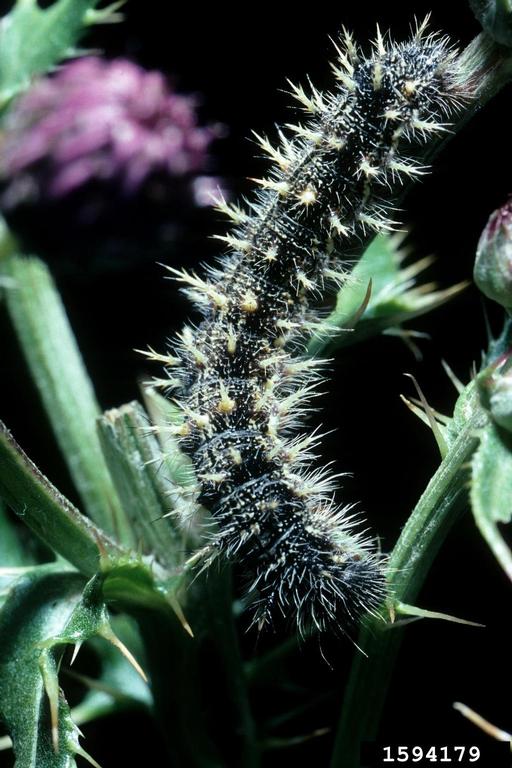
The larval stage of Vanessa cardui (Linnaeus) is known as the thistle caterpillar, while the adult stage of the insect is known as the painted lady. The adult butterfly has a wingspread of 50 millimeters (two inches); the upper wing surface is brown with red and orange mottling and white and black spots. The larvae are light brown to black, spiny, with a pale yellow stripe on each side. Mature larvae are 30 to 35 millimeters (1¼ to 1½ inches) in length. The painted lady butterfly is indigenous to the southern regions of the United States and migrates annually to the northern regions and Canada. Adults appear in May and June. Small, spherical, white eggs are laid on Canada thistle and other food plants. Larvae will feed on the foliage of many different plants and reach maturity in early July.
Plant Response and Damage
Larvae feed on leaves by chewing large holes. When numerous larvae may completely strip infested plants. Larvae can often be detected by the presence of a loose silk webbing.
Management Approaches
Biological Control
Larvae are parasitized by wasps and Tachinid flies. They are susceptible to Bacillus thuringiensis-based insecticides.
Chemical Control
In monitoring the field, use the X‑pattern counting 100 plants per sampling site for a total of 500 plants to determine percent defoliation. While it is fairly unusual to experience economically significant infestations with this pest, consider a treatment if defoliation averages 25 percent on the plants examined. Alternatively, use the table below to determine the potential yield loss from the observed level of defoliation. Insecticide treatments are only recommended when the majority of larvae are under 30 millimeters (1¼ inches) in length, because larger larvae are about to stop feeding. Infestations are often concentrated in areas of a field where Canada thistle plants are abundant.
Estimated % yield reduction from sunflower defoliation occurring at various growth stages (From North Dakota State University Extension Bulletin 25)
| 10 | 20 | 30 | 40 | 50 | 60 | 70 | 80 | 90 | 100 | |
|---|---|---|---|---|---|---|---|---|---|---|
| Growth Stage | ||||||||||
| V-4 to V-5 | 0 | 1 | 2 | 2 | 4 | 4 | 5 | 9 | 14 | 21 |
| V-9 to V-11 | 0 | 2 | 3 | 4 | 5 | 5 | 7 | 11 | 17 | 24 |
| R-1 | 2 | 4 | 6 | 6 | 7 | 9 | 16 | 24 | 34 | 47 |
| R-3 | 2 | 8 | 15 | 19 | 24 | 32 | 44 | 59 | 78 | 99 |
| R-5 | 1 | 3 | 7 | 10 | 16 | 25 | 37 | 49 | 67 | 90 |
| R-7 | 0 | 1 | 3 | 7 | 10 | 13 | 16 | 18 | 20 | 22 |
| R-8 | 0 | 1 | 2 | 3 | 5 | 7 | 8 | 9 | 10 | 11 |
Product list for Painted Lady Butterfly:
| Pesticide | Product/Acre (Fl oz. or oz. product) | Preharvest Interval, remarks |
|---|---|---|
| chlorpyrifos + gamma cyhalothrinR,1,2 | See labels | 45 days. Do not graze. 24 hour REI. Extremely Hazardous to Bees! See labels for additional restrictions for individual active ingredients. |
| Cobalt AdvancedR,1 | 16 - 38 | 45 days. Do not graze. 24 hour REI. Extremely Hazardous to Bees! Maximum 114 fl oz product/acre/season. See labels for additional restrictions for individual active ingredients. |
| gamma cyhalothrinR,1,2 | See labels | 45 days. 24 hour REI. Extremely Hazardous to Bees! |
| lambda cyhalothrinR,1,2 | See labels | 45 days. 24 hour REI. Extremely Hazardous to Bees! |
| BesiegeR | 6 - 10 | 45 days. 24 hour REI. Not more than 31 fl oz/acre/season. |
| zeta cypermethrinR,1,2 | see labels | 30 days. Do not apply more than 0.125 lb ai/acre/crop. Extremely Hazardous to Bees! See label for at-plant application. |
| StallionR,1 | 3.75 - 11.75 | 42 days. 24 hr REI. Extremely Hazardous to Bees! No more than 11.75 oz per application, 35.25 oz per season. See labels for additional restrictions for individual active ingredients. |
| RRestricted use pesticide. 1Labeled for chemigation. 2Generic active ingredient, several formulations. | ||
The information herein is supplied with the understanding that no discrimination is intended and that listing of commercial products, necessary to this guide, implies no endorsement by the authors or the Extension Services of Nebraska, Colorado, Wyoming or Montana. Criticism of products or equipment not listed is neither implied nor intended. Due to constantly changing labels, laws and regulations, the Extension Services can assume no liability for the suggested use of chemicals contained herein. Pesticides must be applied legally complying with all label directions and precautions on the pesticide container and any supplemental labeling and rules of state and federal pesticide regulatory agencies. State rules and regulations and special pesticide use allowances may vary from state to state: contact your State Department of Agriculture for the rules, regulations and allowances applicable in your state and locality.
