Sugarcane aphid
Author: Frank B. Peairs[1]
Identification (and life cycle/seasonal history)
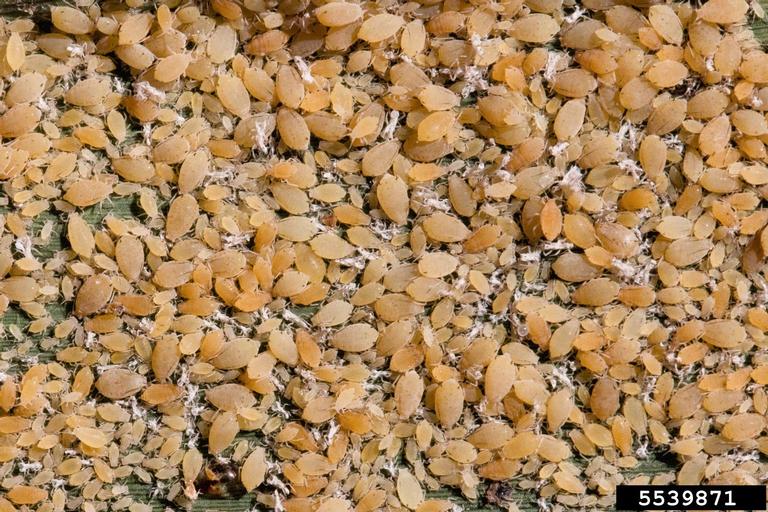
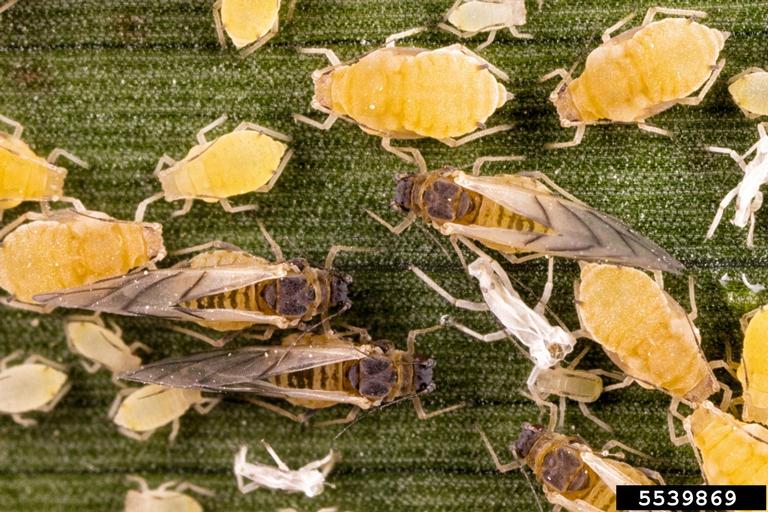
Sugarcane aphids, Melanaphis sacchari (Zehntner), are pale yellow, gray or tan aphids, distinguished from greenbugs by the lack of the dorsal dark green stripe and by having black cornicles, rather than green cornicles with black tips. Adults may be winged or wingless. All sugarcane aphids are female, which give birth to females. During the summer, females start to reproduce within a week and live about 25 days span. Like greenbugs, sugarcane aphids are found in colonies on the underside of the lower leaves. Later they will move into the panicle. Sugarcane aphids overwinter in the south and migrate northward during the summer. This is an emerging problem, so the timing of their arrival is not well understood.
Plant Response and Damage
Similar to greenbugs, sugarcane aphids feed on plant sap, which can result in plant death, stunting, and reduced yields. Further damage is associated with the abundant honeydew produced by this aphid. The honeydew is deposited on leaves and stems and promotes the growth of sooty mold. This prevents sunlight from reaching the leaf, thus reducing photosynthesis and further reducing yield. Additionally, honeydew can interfere with harvest equipment, causing downtime for required cleaning.
Monitoring
Timing of sampling
The appropriate timing of sampling is currently unknown for this region. However, for the last two years the first detection of the aphid in Kansas was in mid July. This would indicate that monitoring should start at the beginning of August. However, follow Extension and other information sources for reports of earlier detection.
Monitoring Techniques
Initially sorghum crops can be monitored for the presence of the shiny, sticky honeydew on lower leaves. Enter at least 10 rows into the field and look for honeydew along 50 row-feet. If honeydew is present, then look for sugarcane aphid colonies on the undersides of the leaves above the honeydew. If no honeydew or no colonies are found, then return the following week. Fields with colonies present should be monitored twice weekly to determine if the threshold described below has been exceeded.
Decision making
This is an abbreviated version of the West Texas treatment guidelines for sugarcane aphid in grain sorghum found in: Knutson, A., R. Bowling, M. Brewer, E. Bynum and P. Porter. 2016. The sugarcane aphid: management guidelines for grain and forage sorghum in Texas. Texas A&M Agrilife Extension ENTO-035, revised.
Determine the percentage of infested plants based on four sets of 10 plants distributed across the field. If the plants are between whorl stage and milk stage, also estimate the aphids per leaf. It is important to treat before the aphids exceed 100 per leaf. Use the following table to determine if treatment is economically justified.
| Crop Stage | Level at which aphids should be treated |
|---|---|
| Preboot | 20% infested plants |
| Boot | 20% of plants with 50 aphids or more per leaf |
| Flowering - milk | 30% of plants with 50 aphids or more per leaf |
| Soft dough | 30% infested plants, areas with heavy honeydew, aphid colonies present |
| Dough | 30% infested plants, areas with heavy honeydew, aphid colonies present |
| Black layer | Heavy honeydew and aphid colonies present, treatment is only to prevent harvest problems, preharvest intervals may limit insecticide choices. |
Management Approaches
Cultural Methods
There are no known cultural methods known to be effective against sugarcane aphid in grain sorghum.
Host Plant Resistance
Expression of tolerance and antibiosis have been observed in certain commercial and experimental sorghum varieties. The hybrid DKS 37-07 is one that is mentioned specifically. Check with your seed dealer regarding varieties that are well adapted to your area and that are resistant or partially resistant to sugarcane aphid.
Biological Control
The predators that attack sugarcane aphid are similar to those that attack greenbug. Several parasitic wasps in the genus "Aphelinus" also attack this aphid, resulting in black mummies. The parasitic wasp that causes greenbug to form tan mummies is not considered effective against sugarcane aphid.
Chemical Control
The products listed for greenbug may be used against sugarcane aphid. However, experience and university testing results suggest that the most effective product available is Sivanto. Transform WG is similarly effective and is available in some states under Section 18 registrations. Be sure to follow resistance management guidelines when treating for sugarcane aphid. For late season infestations, be sure to observe the labeled preharvest interval.
Insecticidal seed treatments also may be effective against sugarcane aphid for 30-40 days after planting. However, since the aphid arrives so late in season this approach is not recommended.
Due to constantly changing labels, laws and regulations, the sponsors of this web site assume no liability for the suggested use of any chemicals noted in the management section. Contact your local pest management personnel for current information on labeled pesticides that can be used for the intended plant disease, insect pest or weed.

