HPIPM:Greenbug Sorghum
Author: John B. Campbell & Frank B. Peairs[1]

Identification (and life cycle/seasonal history)
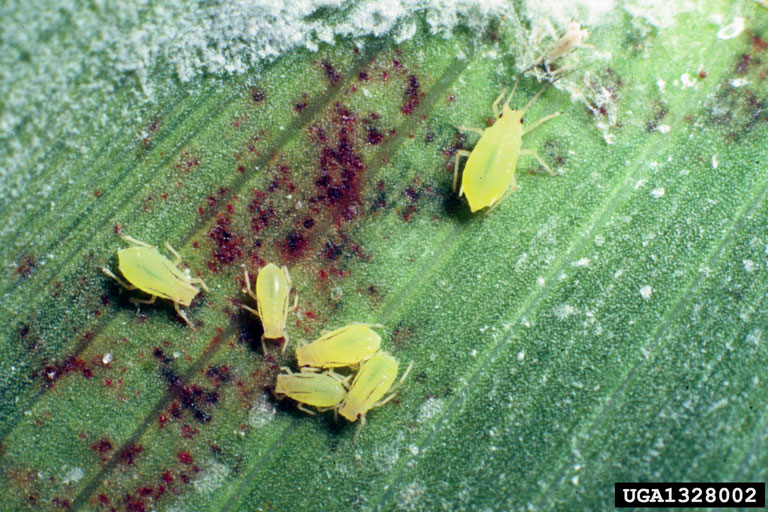
Greenbugs, Schizaphis graminum (Rondani), are light green aphids with adults having a darker green stripe down the back. Adults may be winged or wingless. All wingless greenbugs are female and they give birth to females. During the summer, females start to reproduce within a week and may produce as many as 80 offspring during their 25 day adult life span. The legs of greenbugs are green but their feet are black. The cornicles (small pipes near the rear end) are green with black tips. Generally, greenbugs are found in colonies on the underside of the lower leaves. Sometimes they may also be found in the whorl of the plant until the head emerges. Greenbugs migrate north from Texas and Oklahoma on weather fronts. This migration generally occurs in late May or early June but usually do not reach economic levels until late June or July.
Plant Response & Damage
In the process of feeding, greenbugs inject toxins into the plant, which apparently break down cell walls to facilitate feeding. The toxins cause a red discoloring of the leaves, which in conjunction with removal of the cell contents, will cause the death of the leaf if enough greenbugs are feeding. During the digestive process, greenbugs disperse a sticky, shiny material called honeydew from the cornicles. Honeydew may interfere with the transpiration process of the plant.
Management Approaches
Cultural practices
Research indicates that greenbugs are most attracted to fields with reduced vegetative cover. Higher residue fields such as ecofallow or conservation tillage are less attractive. Greenbugs apparently respond negatively to background conditions of the host plant associated with crop residues, canopy and the reduced or no-tilled soil surface. Research in Oklahoma and Nebraska indicates that no-till, later planting dates, and resistant hybrids are complementary and will significantly reduce greenbug populations. Reflective conditions seem to trigger a behavioral response in greenbugs; the more reflective the greater the attraction, even to the point of difference in straw color. Dark straw is less attractive than the lighter colored straw.
Plant Resistance
Sorghum varieties have been developed that have resistance to greenbugs; most had tolerance and a few had antibiosis, or both tolerance and antibiosis. However, several strains (biotypes) of greenbugs have developed over time. The biotypes generally can't be distinguished morphologically but differ metabolically or physiologically. Currently biotype "E" and "I" are the most dominant in the Great Plains. Plant breeders developed greenbug resistant varieties of sorghum but in time, the new biotypes, i.e. "C," then "E" and now "I," overcome the resistance (tolerance) and cause serious damage to the resistant varieties.
Biological Control
The two most dramatic biological control agents for greenbugs are the parasitic wasp and a fungus disease. The wasp deposits eggs inside of greenbugs and the wasp larvae feeds inside of the greenbug, killing it in the feeding process. The dying greenbugs turn orange, then brown or tan when the greenbug dies. The wasp-infested greenbugs are called "mummies." The adult wasp emerges inside the mummy and cuts a circular hole in the cornicle area to exit. The wasp has a short life cycle and several generations occur during the summer.
Control of greenbugs by the parasitic wasp is quite dramatic under certain conditions. Generally, if more than 10 to 15 percent of the greenbug population is parasitized, control will occur within a week. Determining the number of "mummies" in relation to the non-parasitized greenbugs will give the percent parasitized.
Other biological agents that use greenbugs as hosts include lady beetles and their larvae, syrphid flies, damsel bugs, green lacewing larvae and if a wet, cool period occurs, a fungus disease. Dead greenbugs that are whitish or light tan with white growths protruding from them are indicative of the fungus disease.
Chemical control
Greenbugs move north from the southern Great Plains states on storm fronts. Sorghum should be surveyed following these fronts if greenbug activity is heavy in the southern states. The greenbugs that migrate are winged and can often be seen flying on a calm day following the passage of a storm front. If greenbugs become established in sorghum, weekly surveys should be made to determine how rapidly they are increasing. Predators and parasites may keep the population in check or strong wind or hard rain may knock the greenbugs from the plant, and, if this occurs, they seldom recover enough to become economic.
Insecticide control decisions should be based on economic thresholds that vary with the growth stage of the plant. At the seedling stage, treatment would be recommended when colonies are present on 15 percent of the plants and yellowing or spotting are present on the leaves. Prior to the boot stage, treatment should occur when greenbug colonies are causing red or yellow spotting on the lower leaves of most plants and parasitism is less than 20 percent. From the boot to soft dough stage, treatment should be made when greenbug colonies are present on most plants and before the lower leaf is killed and parasitism is below 20 percent.
Forage sorghum are generally planted later than grain sorghum and consequently, runs a greater risk of greenbugs infestation in the seedling stage. Treat if seedlings have 25 to 30 greenbugs per plant or if 25 percent of the lower leaves of larger plants have greenbugs and show damage.
Due to constantly changing labels, laws and regulations, the sponsors of this web site assume no liability for the suggested use of any chemicals noted in the management section. Contact your local pest management personnel for current information on labeled pesticides that can be used for the intended plant disease, insect pest or weed.
