HPIPM:Grasshoppers Sunflowers
Author: Frank B. Peairs[1]
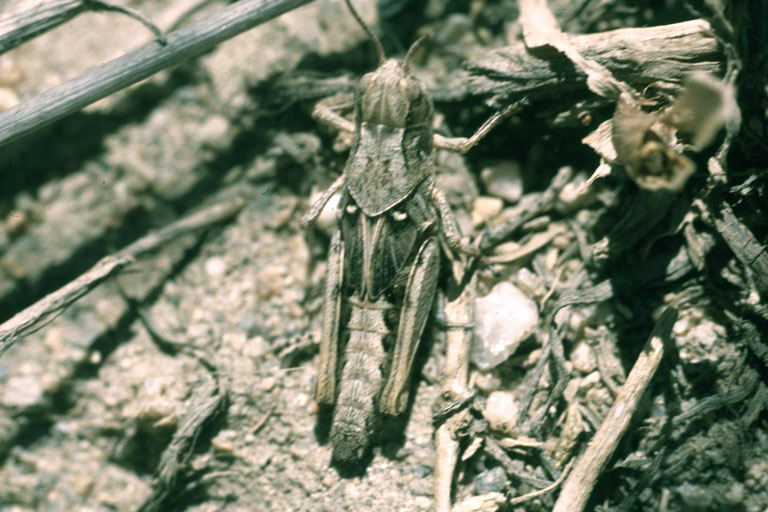


Field Biology and Identification
There are many different species of grasshoppers, with some having a greater pest potential than others. Correctly identifying a species is important because (1) species vary in their biotic potential and in their capacity for causing damage; (2) depending on their food habits, species may be either pests or beneficials; (3) certain species of pest grasshoppers are highly migratory and often pose a serious threat to distant crops; (4) species vary in their seasonal cycle (period of hatching, development, and reproduction) which in turn affects the timing of control treatments; (5) because current chemical and biological methods of controlling grasshoppers are more sophisticated, their effective use requires greater knowledge of the pests' life histories and habits; (6) as environmental impacts of control are more finely evaluated, identification of species is important in the selection of management strategies. Common pest species include: clearwinged grasshopper, Camnula pellucida; differential grasshopper, Melanoplus differentialis; migratory grasshopper, Melanoplus sanguinipes; twostriped grasshopper, Melanoplus bivitattus; and redlegged grasshopper, Melanoplus femurrubrum.
Most grasshoppers overwinter as eggs in the form of a pod laid in the soil. These elongate-shaped pods may contain from 20 to 120 eggs each. Eggs hatch into nymphs in late May and June, maturing in two to three months. By August most nymphs have matured to the adult stage. Grasshoppers feed during the day and rest during the afternoon and night on vegetation.
The following website provides a comprehensive source of information on grasshopper biology, ecology, identification and management of grasshoppers and crickets in North America. [2] Grasshoppers can be a pest to many crops. There are many species of grasshoppers, but only a few actually have pest potential. Populations may vary greatly from year to year and season to season. Often grasshopper populations develop in uncultivated areas and move into cultivated fields. Mostly grasshoppers feed on leaves.
Monitoring
Hazard Maps are developed each year as a cooperative effort of USDA-APHIS-PPQ and are available at the following site. http://www.sidney.ars.usda.gov/grasshopper/
Management
Table 1. Treatment thresholds for immature and adult grasshoppers (from University Minnesota)
| Rating | Immatures/yd2 | Adults/yd2 | ||
|---|---|---|---|---|
| Margin | Field | Margin | Field | |
| Light | 25-35 | 15-25 | 10-20 | 3-7 |
| Threatening | 50-75 | 30-45 | 21-40 | 8-14 |
| Severe | 100-150 | 60-90 | 41-80 | 15-28 |
| Very Severe | 200+ | 120+ | 80+ | 29+ |
Chemical Control
Treat crop borders when immatures are small and numbers are moderate. Timing of grasshopper control depends on the potential for crop loss, crop value, size (stage) of grasshoppers present. Grasshopper control is most effective before the insects become large nymphs or adults, as these stages are more mobile and more difficult to control.
Chemical control may be justified when adult grasshopper populations are threatening, according to the population densities shown in Table 1. Re-infestation originating from outside the field may occur after 10 to14 days. Use the higher dosages for adults, lower for the more immature. Sufficient gallonage is important. Products for control of grasshoppers in noncrop areas adjacent to corn fields include acephate, carbaryl, and Dimilin 2L. See A Guide to Grasshopper Control in Cropland in this guide for more information.
Product list for Grasshoppers
| Pesticide | Product/Acre (Fl oz. or oz. product) | Preharvest Interval, remarks |
|---|---|---|
| Beauveria bassiana1,2 | See labels | 0 days. 4 hr REI. Potentially pathogenic to bees; avoid applying where bees are foraging or around hives. |
| beta-cyfluthrinR,1,2 | 2.0 - 2.8 | 30 days. 12 hour REI. See labels. Extremely Hazardous to Bees! |
| carbaryl1,2 | See labels. | 60 days seed, 30 days grazing or harvest for forage. 12 hour REI. Extremely Hazardous to Bees! |
| chlorantraniliprole1,2 | See labels | 21 days. 4 hour REI. No more than 0.2 lb a.i./acre/season. |
| chlorpyrifosR,1,2 | See labels | 42 days. 24 hour REI. Do not graze. Extremely Hazardous to Bees! |
| chlorpyrifos + gamma cyhalothrinR,1,2 | See labels | 45 days. Do not graze. 24 hour REI. Extremely Hazardous to Bees! See labels for additional restrictions for individual active ingredients. |
| Cobalt AdvancedR,1 | 6 - 13 | 45 days. Do not graze. 24 hour REI. Extremely Hazardous to Bees! Maximum 114 fl oz product/acre/season. See labels for additional restrictions for individual active ingredients. |
| cyfluthrinR,1,2 | See labels | 30 days. 12 hour REI. See labels. Extremely Hazardous to Bees! |
| deltamethrinR,1,2 | See labels | 21 days. Do not graze or feed treated foliage. 12 hour REI. Do not apply more than 0.045 lb ai/acre/crop. Extremely Hazardous to Bees! |
| esfenvalerateR,1,2 | See labels | 28 days. Do not apply more than 0.2 lb ai/acre/crop. 12 hour REI. Extremely Hazardous to Bees! |
| gamma cyhalothrinR,1,2 | See labels | 45 days. 24 hour REI. Extremely Hazardous to Bees! |
| lambda cyhalothrinR,1,2 | See labels | 45 days. 24 hour REI. Extremely Hazardous to Bees! |
| BesiegeR | 6 - 10 | 45 days. 24 hour REI. Not more than 31 fl oz/acre/season. |
| zeta cypermethrinR,1,2 | see labels | 30 days. Do not apply more than 0.125 lb ai/acre/crop. Extremely Hazardous to Bees! See label for at-plant application. |
| StallionR,1 | 5.0 - 11.75 | 42 days. 24 hr REI. Extremely Hazardous to Bees! No more than 11.75 oz per application, 35.25 oz per season. See labels for additional restrictions for individual active ingredients. |
| RRestricted use pesticide. 1Labeled for chemigation. 2Generic active ingredient, several formulations. | ||
The information herein is supplied with the understanding that no discrimination is intended and that listing of commercial products, necessary to this guide, implies no endorsement by the authors or the Extension Services of Nebraska, Colorado, Wyoming or Montana. Criticism of products or equipment not listed is neither implied nor intended. Due to constantly changing labels, laws and regulations, the Extension Services can assume no liability for the suggested use of chemicals contained herein. Pesticides must be applied legally complying with all label directions and precautions on the pesticide container and any supplemental labeling and rules of state and federal pesticide regulatory agencies. State rules and regulations and special pesticide use allowances may vary from state to state: contact your State Department of Agriculture for the rules, regulations and allowances applicable in your state and locality.
