HPIPM:Dectes stem borer SF
Author: Frank B. Peairs[1]

Identification (and life cycle/seasonal history)
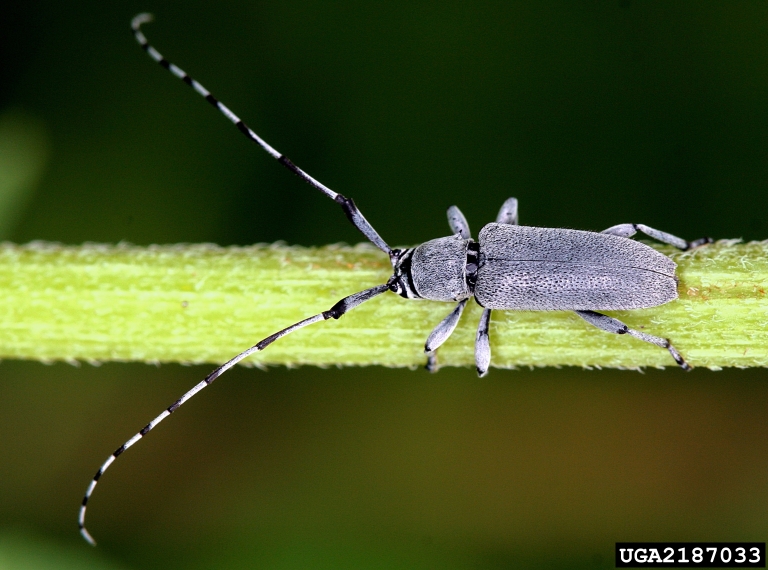
Dectes stem borer adults are bluish-gray in color, range in length from 1.0 to 2.0 cm (3/8 to 3/4 inches), and have antennae longer than the body. They are found resting on the undersides of leaves, or moving on or among plants. The white eggs are curved and found in hollow pith cavities in tender petiole or stalk tissue. Larvae are creamy white in color, tapered toward the rear, and legless, with marked body segmentation.
Adults emerge over several weeks in mid-summer, mate, and feed on a variety of hosts. They live one (males) to two (females) months. Egg laying starts about two weeks after emergence. Emergence peaks in mid-June, but may extend into July. After hatching, larvae bore up and down in the central pith. They do not have a specific tunneling patter and are found at any height within the stalk. However, mature larvae move to the base of the stalk, where they girdle the stem. many infestations are only noticed in late stages, when plants are beginning to lodge. Plants girdled by mature larvae in preparation for overwintering appear as if they had been neatly sawed off close to ground level. The tunnel below the girdle is plugged with chewed plant fibers, forming the chamber in which they overwinter. Larvae are cannibalistic and generally only one survives per plant.
Plant Response and Damage
There is evidence that Dectes stem borer feeding does not reduce sunflower seed yield, size or oil content. However, their girdling behavior may result in significant lodging and harvest losses.
Monitoring
Timing of sampling
Adults are found in sunflower starting in mid-June and abundance peaks in mid-July.
Monitoring Techniques
Adults may be observed on plants. Sweep netting has been used to monitor adults in soybean, but this may not be feasible in sunflower.
Decision making
Treatment guidelines are not available for this pest in sunflower.
Management Approaches
Cultural Methods
Stem diameter is an important consideration in Dectes stem borer management. Stems one inch or less in diameter are the most prone to girdling and lodging. Thicker stems are more likely to tolerate girdling without lodging. Also stem desiccation appears to trigger girdling, and smaller stems desiccate more quickly, resulting in earlier girdling and lodging. Thus, thicker stems would be less likely to lodge before harvest. Cultural practices, such as lower plant populations, that promote thicker stems should help reduce lodging and harvest losses.
Host Plant Resistance
Sunflower hybrids resistant to Dectes stem borer are not available.
Biological Control
Effective biological control agents are not available.
Chemical Control
StallionR and Mustang MaxxR are labelled for control of Dectes stem borers in sunflower. Treatments would be directed at adults to prevent egg laying, and two or more applications likely would be necessary. It is unknown whether this approach would be economically feasible.
The information herein is supplied with the understanding that no discrimination is intended and that listing of commercial products, necessary to this guide, implies no endorsement by the authors or the Extension Services of Nebraska, Colorado, Wyoming or Montana. Criticism of products or equipment not listed is neither implied nor intended. Due to constantly changing labels, laws and regulations, the Extension Services can assume no liability for the suggested use of chemicals contained herein. Pesticides must be applied legally complying with all label directions and precautions on the pesticide container and any supplemental labeling and rules of state and federal pesticide regulatory agencies. State rules and regulations and special pesticide use allowances may vary from state to state: contact your State Department of Agriculture for the rules, regulations and allowances applicable in your state and locality.

