HPIPM:Banded Sunflower Moth
Author: Frank B. Peairs[1]


Field Biology and Identification
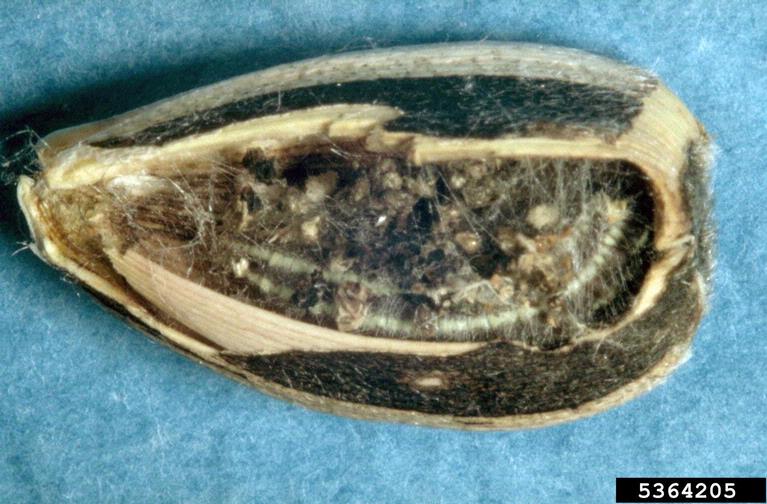
Adult banded sunflower moths, Cochylis hospes Walsingham, are straw‑colored and have a 12.5 millimeter (1/2 inch) wingspan. The front pair of wings have a brown triangular area near the middle. In the early stages of growth, larvae are cream colored, whereas mature larvae (8.5 to 12.5 millimeters, or 1/3 to 1/2 inches long) range from pink to reddish brown with a brown head capsule. Adults begin to emerge from June to early July. Peak egg laying coincides with the late bud crop growth stage. Larvae feed on sunflower heads through late September to early October. Larvae overwinter in the soil and pupate in June of the following year. Adults are most active during the early morning and early evening. During the day they rest quietly underneath the lower leaves of sunflower plants, but flutter from plant to plant when disturbed.
Plant Response and Damage
Larvae feed primarily on seed and florets in the central portion of the head. A single larvae may feed on from three to five seeds. As many as 30 larvae have been found in a single head.
Management Approaches
Chemical Control
Applications are made to prevent moths from laying eggs. Scouting in the early morning or early evening will provide the most accurate counts, since moths are most active at these times. Pheromone traps can be used to determine when scouting should be started, but a pheromone-based treatment threshold is not available. When scouting, sample sites should be 75 to 100 feet from the edge of the field. Use an X‑pattern, counting moths on 20 heads per sampling site for a total of 100 heads. Research is continuing into accurate economic thresholds, however one moth per two plants is currently considered to be a reasonable economic threshold level.
Insecticide applications are made to prevent moths from laying eggs. Eggs are laid during the bud stage, so treat for banded sunflower moth at early bloom (R5.1).
Product list for Banded Sunflower Moth:
| Pesticide | Product/Acre (Fl oz. or oz. product) | Preharvest Interval, remarks |
|---|---|---|
| Bacillus thuringiensis1,2 | See labels | 0 days. 4 hour REI. See labels. |
| beta-cyfluthrinR,1,2 | See labels | 30 days. 12 hour REI. Maximum 8.4 fl oz/acre/season. Extremely Hazardous to Bees! |
| chlorantraniliprole1,2 | 14-20 | 21 days. 4 hour REI. Do not apply more than 0.2 lb ai/acre/crop. |
| chlorpyrifosR,1,2 | See labels | 42 days. 24 hour REI. Do not graze. Extremely Hazardous to Bees! |
| chlorpyrifos + gamma cyhalothrinR,1,2 | See labels | 45 days. Do not graze. 24 hour REI. Extremely Hazardous to Bees! See labels for additional restrictions for individual active ingredients. |
| Cobalt AdvancedR,1 | 16 - 38 | 45 days. Do not graze. 24 hour REI. Extremely Hazardous to Bees! Maximum 114 fl oz product/acre/season. See labels for additional restrictions for individual active ingredients. |
| cyfluthrinR,1,2 | See labels | 30 days. 12 hour REI. See labels. Extremely Hazardous to Bees! |
| deltamethrin R,1,2 | See labels | 21 days. Do not graze or feed treated foliage. 12 hour REI. Do not apply more than 0.045 lb ai/acre/crop. Extremely Hazardous to Bees! |
| esfenvalerateR,1,2 | See labels | 28 days. 12 hour REI. Do not apply more than 0.2 lb ai/acre/crop. Extremely Hazardous to Bees! |
| gamma cyhalothrinR,1,2 | See labels | 45 days. 24 hour REI. Extremely Hazardous to Bees! |
| lambda cyhalothrinR,1,2 | See labels | 45 days. 24 hour REI. Extremely Hazardous to Bees! |
| BesiegeR | 6 - 10 | 45 days. 24 hour REI. Not more than 31 fl oz/acre/season. |
| zeta cypermethrinR,1,2 | see labels | 30 days. Do not apply more than 0.125 lb ai/acre/crop. Extremely Hazardous to Bees! See label for at-plant application. |
| StallionR,1 | 5.0 - 11.75 | 42 days. 24 hr REI. Extremely Hazardous to Bees! No more than 11.75 oz per application, 35.25 oz per season. See labels for additional restrictions for individual active ingredients. |
| RRestricted use pesticide. 1Labeled for chemigation. 2Generic active ingredient, several formulations. | ||
The information herein is supplied with the understanding that no discrimination is intended and that listing of commercial products, necessary to this guide, implies no endorsement by the authors or the Extension Services of Nebraska, Colorado, Wyoming or Montana. Criticism of products or equipment not listed is neither implied nor intended. Due to constantly changing labels, laws and regulations, the Extension Services can assume no liability for the suggested use of chemicals contained herein. Pesticides must be applied legally complying with all label directions and precautions on the pesticide container and any supplemental labeling and rules of state and federal pesticide regulatory agencies. State rules and regulations and special pesticide use allowances may vary from state to state: contact your State Department of Agriculture for the rules, regulations and allowances applicable in your state and locality.
