HPIPM:Alfalfa Blotch Leafminer
Author: Frank B. Peairs[1]
Identification (and life cycle/seasonal history)
The adult alfalfa blotch leafminer, Agromyza frontella (Rondani) (Diptera: Agromyzidae), is a small black fly (Figure 1). They are about an eighth of an inch long and have a hump on their back. The small, yellow maggots are found in mines in leaf tissue. The alfalfa blotch leafminer has recently been found in Colorado but has not become an important pest. It has caused economic problems in the eastern United States and the Midwest.
Alfalfa blotch leafminers prefer to feed on alfalfa. Hop medic also is a suitable host plant. Starting in April, females lay an average of three eggs on the bottom side of a single leaf. Females produce an average of 140 eggs. Females also feed by puncturing leaves with their ovipositors, creating characteristic "pinholes," and consuming plant juices. A single female may create more than 3750 pinholes during her lifetime. Eggs hatch within 3 to 18 days depending on temperature.
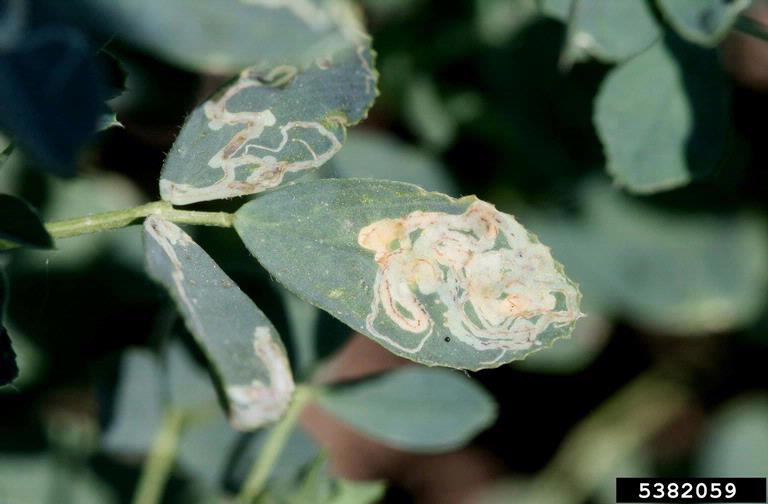
Larvae feed within leaves for 6 to 17 days. They create characteristic mines as they consume the mesophyll of the leaf (Figure 2). Mines are comma shaped pattern, curved and wider at one end. Blotches are often confused with mines of the serpentine leafminer; however, latter is straight with a thin dark line down the middle. Larvae can be cannibalistic to other larvae in the same leaf. Fully grown larvae drop to the ground and burrow into the soil to pupate. Next generation adults will emerge 16-57 days later. Two to four generations may occur per year, and each generation takes about 30 days to complete.
Plant Response and Damage
Observations in Canada and the northeastern US suggest that damage from alfalfa blotch leafminer adult and larval feeding may reduce alfalfa yields by 7-20% and protein content by 10-20%. Within a field, it is not uncommon for 70% or more of the leaflets to be attacked. The wounds also increase the susceptibility of alfalfa to diseases, especially spring black stem. The economic impact of damage caused by ABL is unclear, but the visible damage caused by even low numbers of flies can be impressive.
Management Approaches
Cultural Methods
Early cutting may reduce damage in the first cutting. Hay should be removed from the field within a few days to prevent pupae from surviving.
Biological Control
Biological control methods for the alfalfa blotch leafminer. A parasitic braconid wasp (Dacnusa dryas (Nixon) has been released in known infestation areas and may reduce populations by 98%. This wasp needs about 3-5 years to become established and effective, and it may not spread as quickly as its host.
Chemical Control
The easiest way to determine infestation by the alfalfa botch leafminer is to examine leaflets for pinhole adult feeding scars. These can be observed when held up to the sun. Consider treatment when there are over 250 pinholes per trifoliate (three leaves) or if 30-40% of leaflets contain pinholes. Since treatment targets the adults, larval damage is not used to determine the need to treat.
Due to constantly changing labels, laws and regulations, the sponsors of this web site assume no liability for the suggested use of any chemicals noted in the management section. Contact your local pest management personnel for current information on labeled pesticides that can be used for the intended plant disease, insect pest or weed.
