Explore Your World With Lewis and Clark

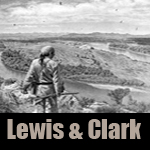
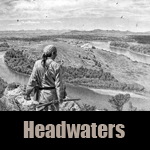
Montana rancher and artist, Don Greytak, and Idaho artist Barbara Peets produced illustrations to increase public awareness of native and non-native plant species along the Missouri. Don sat with the project manager and designer, Carla Hoopes, at the Missouri Headwaters on the overlook from which Don portrayed the convergence of the Jefferson, Madison, and Gallatin rivers at the arrival of Meriweather Lewis and William Clark on July 27, 1805.
Don notes that he watched the Milk River throughout the course of his life braid a path back and forth across the landscape. Don's insights prompted him to visualize the Missouri Headwaters at a point in time after the braiding up to 1805--not where the river flows today.
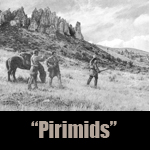
The Salmon Challis National Forest education coordinator Pat Hurt coordinated Idaho's Tower Creek Pirimids artistic contribution by Barbara Peets. Barbara's love of Idaho's landscapes and Don's life experiences, combined with knowledge gleaned from the Lewis and Clark journals, bring education to life to decrease weed spread by visitors.
The project steering committee was led by Alan Knudsen when he managed the Missoula weed education program. Montana Department of Agriculture state weed coordinator Barbra Mullin and industry’s Bob Ullom joined Alan and Carla to set direction for the project.
Background. The Lewis and Clark Placemat Project
Interpretations from guides, historians, and land managers help visitors become stewards of the historic trails, rivers, and parks along their way.
Journey through Time to Explore Lewis and Clark's Changing Landscapes
Follow the icons to learn historical uses of native plants and what you can do to
stop weed spread at each of these national historic sites along the Missouri River.
Play the games and learn the vocabulary to identify three native and three invasive
plants at each site.
 :
 :
 :
 :
 :
 :
 :

Conservation partners came together to create a series of information resources and games to help travelers engage in identification of native plants and non-native invasive plants they may encounter at a site.
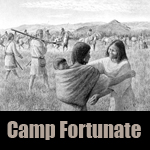
Restaurants used the flyers as placemats and tourist vendors handed them out to visitors during interpretive talks. Don Greytak spent time at each site visiting with historians, reading the journals, and comparing his life experiences on the Milk River to envision and portray in illustration how the events on the actual day or days that played out for Meriwether Lewis and William Clark.
 :

Travelers came from all over the world to visit the historic trail during the Bicentennial Celebration.
Education flyers were collected by travelers at scenic and historic venue, court house lobbies and restaurants. The Bicentennial Celebration national committee selected the project for archive in the permanent collection at the Lewis and Clark National Historic Trail Interpretive Center in Great Falls.
Each year in April, news releases included television and radio public service announcements written by Carla Hoopes and created by Earthtalk Studios. News media professionals learned that noxious and invasive weeds begin to surface as snow retreats across Montana’s landscapes. The 30-second spots were peer-reviewed by stakeholders and agency land managers who work together across jurisdictions. The messages represent statewide consensus on what volunteers can do about spotted knapweed on public trails.

Related Lesson Plans
Our Wetland Project K-6 Aquatic Invasives Activities from the Western Regional Panel on Aquatic Nuisance Species All Users of Water Trails Education
Changing Landscapes  :
 :

- learn that landscapes change over time at different rates
- learn that many factors influence the changing of landscapes
- create maps to demonstrate the effects of noxious weeds over time
Posters and Games for each Lewis and Clark National Historic Trail Site
You can carry on this important work in the classroom by downloading
the higher resolution activity posters for each historic location.
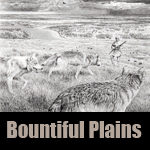
Lewis and Clark on Bountiful Plains of the Missouri : Games
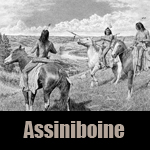
Lewis and Clark sighted by the Assiniboine Indians : Games
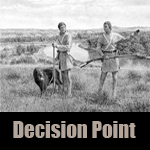
Lewis and Clarks Quandry at Decision Point : Games
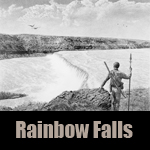
Re-discover nature at Rainbow Falls : Games
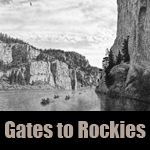
Lewis and Clark at Gates of the Rocky Mountains : Games
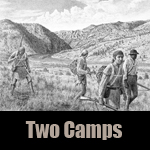
William Clark and his scouts at Two Camp : Games
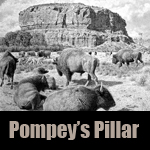
Lewis and Clarks vista point at Pompeys Pillar : Games
A look back at the Missouri Headwaters : Games
Lewis and Clark Reunion at Camp Fortunate : Games
Lewis and Clark at the Tower Creek Pirimids : Games
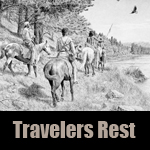
Lewis and Clark along the river near Travelers Rest : Games
 :
Peer Review. The information provided in Explore Your World With Lewis and Clark pages was peer-reviewed by Ken Soderberg (Montana Fish, Wildlife and Parks), Adam Brooks (Montana Fish, Wildlife and Parks), Melissa Brown (Montana Science Institute), Jay Cole (Montana Department of Agriculture), Stuart Doggett (Montana Innkeepers Association), Jim Freeman (Montana Weed Control Association), Tom Greason (Montana Fish, Wildlife and Parks), Cynthia Kingston (Citizens for Weed Free Future), Melanie Lafley (City of Helena, Larry Lambwet (Ruby’s Reserve Street Inn), Kelly Leo (Yellowstone County), Larry Merkel (Heritage Trail (L&C), Mary Kay Minor (GranTree Inn), George Beimel (Madison Valley), Jim Bott (Custer County High School), Carol Crockett (Montana), Shana D. Wood (Montana State University), Richard Fichtler (Bureau of Land Management), Alan Knudsen (Missoula County), Marty Malone (Park County); Dave Schulz (Madison County), David Martin (Montana Department of Natural Resources and Conservation), Dave Burch (Montana Department of Agriculture), Gary Olsen (FTA), Leah Olson (Leah Olsen Real Estate), Mark Petroni (Forest Service), Ann Rauser (Browadwater County), Carolyn Rogers (Lewis and Clark Chapter), Lorrene Schardt (Bureau of Land Management), Bob Ullom (Wilbur-Ellis Compny), Sara Waller (Travel Montana), Matt Wilhelm (International Flyfishing Federation), Sue Noggles (Natural Resources Conservation Service), Christopher Marosek, Gayle Trusler (Bureau of Reclamation), Sara Scott (Forest Service), Kim Prill (Bureau of Land Management), Amy Teegarden (Forest Service), Elleln Baumier (Montana), Victor Bjornberg (Montana), Clink Blackwood (National Lewis and Clark Historic Trail Interpretive Center – Great Falls), Shannon Health (Fish and Wildlife Service), Laurie Heupel (National Park Service), and Steven Morehouse (Bureau of Reclamation).
A letter from Montana’s Governor, December 12, 2001. Dear Mr. Greytak: I would like to express my sincere thanks for your support of the Montana weed control effort and the Statewide Weed Education and Awareness Campaign. Your illustrations for the Lewis & Clark placemat project have made it a very special and effective awareness program for the state and our visitors, as we get closer to the Lewis and Clark Bicentennial. I was pleased to receive one of your specially signed placemats illustrating Rainbow Falls. I have also heard about the Three Forks design, and look forward to seeing the complete set as they are developed and printed. Thank you again for your very generous contribution to this important program. Sincerely, Judy Martz, Governor. c: Ralph Peck, Director, Montana Department of Agriculture
- Content for Biocontrol in Your Backyard is provided by individual program sponsors.
- Content is formatted and uploaded by InterMedia
- The Biocontrol In Your Backyard Portal collaboration with The Bugwood Network and its content accessible
- format are sponsored by USDA Forest Service, Forest Health Protection, Forest Health Technology Enterprise Team.
