Coleoptera Families 3
Meloidae: blister beetles
Biology and Behavior: Blister beetles are a moderately-sized group of distinct beetles with about 2,500 species worldwide. Their common name is based on the fact that adults reflexively bleed an oily substance called cantharidin, familiarly called "spanish fly". This substance is used for defense, and can cause blisters to form on skin and mucous membranes to bleed. Though their life history is somewhat similar between groups, they are a good example of adults and larvae using different food resources. Adults have a fairly simple lifestyle, feeding on plant tissue (leaves and flowers), eating pollen or drinking nectar (some even have elongate, sucking mouthparts in addition to biting mandibles). Most larval blister beetles, however, have a complex mode of life called hypermetamorphosis. This occurs because the larvae are parasites (and kleptoparasites - ones that steal food from their hosts) and need to adapt to the many actions they must take. First they are active insects (called triungulins), with legs and a hardened body. These larvae either actively find the nests of their host, or hitch rides back to the nest on adults. Some even mimic flowers and produce scents to attract the adult host. Once in the nest, the larvae transform into more grub-like insects, that sit and become fat while feeding on the food stores, eggs, larvae and pupae of the host. Diets of Meloidae include food stores and young of bees and wasps, and grasshopper eggs. Blister beetles are most often found in grasslands/fields or in arid regions.
Economic Importance: This family can be beneficial or pestiferous. Larvae of some attack grasshoppers and locusts, helping to control pest populations, and adults may be important pollinators in some areas by visiting flowers and transporting pollen. On the other hand, blister beetles can be detrimental to agriculture and human endeavors. Some adults (such as Epicauta sp.; right) are pests of crops like alfalfa, clover, cotton, potatoes, pearl millet, and others, damaging plants by feeding on leaves and flowers. Larvae may also reduce pollination potential by parasitizing bees. Lastly, cantharidin produced by these beetles, though sometimes medically important, can cause pain, physical damage, and even death in humans and animals (especially when ingested). In fact, horses and livestock that feed on hay that contains either adult blister beetles or cantharidin can become sick and, especially in horses, die from ingesting as little as 30-50 individuals.
How to identify Meloidae: Blister beetles range in size from 3-70mm (most being 10-20mm). They come in various forms and colors. Colors include black, grays, blues, purples, greens, oranges, yellows and reds; some are patterned with stripes, spots or blotches, while others are metallic or sculptured. All are fairly soft-bodied, and their elytra are leathery or shortened (and sometimes absent). Generally blister beetles have long legs, long antennae, and a slightly-elongate to heart-shaped head on a distinct neck. Their pronotum is thinner than both their head and elytra, and barrel-shaped. The antennae of Meloidae are attached near the eyes and generally filiform to slightly serrate, though some groups have several strangely modified antennal segments. All have a 5-5-4 tarsal formula and an elongate blade under each tarsal claw (the main claws also being toothed in many species). Larvae are difficult to describe, being rarely seen except perhaps on flowers, on adult hosts or in the nests of their hosts. Also since the larvae undergo hypermetamorphosis they change form frequently.
Links & References:
Tenebrionidae: darkling beetles and mealworms
Biology and Behavior: Darkling beetles (about 20,000 species worldwide) are some of the most common beetles in the world and have many forms, biologies and behaviors. Their highest diversity is in arid regions, but they can be found many places. Larvae (often called mealworms) are generally scavengers, but also feed on fungus, plant materials or on other insect larvae (predators). Larvae and adults can be found beneath the bark or in tunnels of rotting wood, in fruiting bodies of many types of fungi, or in soil and leaf litter. Some species are found in animal nests, including birds, mammals, ants, bees and termites. Many live in sand dunes near the coast or in deserts. Darkling beetles are sometimes flightless, with short or absent hind wings and fused elytra; this is sometimes an adaptation to dry areas, so the beetles do not lose much water from under their elytra. Some species are known to produce noxious chemicals (often from their rear ends) that deter predators, even going so far as to display their potency with their head toward the ground and their abdomen in the air. Tenebrionidae are sometimes known to live for long periods compared to other insects, with adults sometimes living for 2 or more years.
Economic Importance: The most destructive darkling beetles are those that attack stored foods and grains. The two most important species are the red flour beetle (Tribolium castaneum) and the confused flower beetle (Tribolium confusum; right), both of which attack stored grains, flour, and other dried commodities as larvae and adults. Not only do they damage stored products, but they defecate and die in the food and can also produce foul smells. Another darkling beetle, the lesser mealworm (Alphitobius diaperinus [1]) is a common inhabitant of poultry facilities. This species helps reduce pest fly numbers through predation, but are also known to be pests by damaging insulation and other materials, and by their potential to transmit pathogens to poultry (such as viruses and bacteria, e.g. Salmonella and E. coli). Although some darkling beetles may cause damage, others are important because they are raised as food for pets (e.g., reptiles and fish). Some are also predators of pest insects, like bark beetles (Scolytinae).
How to identify Tenebrionidae: Darkling beetles range in size from 2-80mm long (most being 10-15mm), and adults come in many shapes, textures, and colors. The family is perhaps the most variable of any family of beetles in terms of how they look. As their name suggests, many are black, brown/dark red, or gray. However, some darkling beetles are brightly-patterned, metallic or textured with bumps, scales or dense hairs. Their body shape also varies greatly. Most are cylindrical and slightly flattened, being rounded around the edges. Some have bulging bodies with humpbacks and long legs, and others are almost spherical. A few even resemble flattened seeds or pie dishes[2]! The defining features of the family include the following: antennae usually 11-segmented and moniloform or with a slight, gradual club (though sometimes close to filiform); eyes often with a notch created by a sharp ridge, with the antennae attaching below the ridge; and almost always having a 5-5-4 tarsal formula. Larvae are elongate, cylindrical, shiny, and reddish-brown or slightly darkened (right). They have a round head with short, thick mandibles. The tip of the abdomen often has two spines, but it can be pointed, blunt, or with a thorny plate.
Links & References:
Cerambycidae: longhorn beetles or round-head borers
Biology and Behavior: Longhorn beetles, sometimes called round-head borers based on their larvae, are a diverse group of medium to extremely large beetles found all over the world. There are currently over 20,000 described species making it among the largest families of insects. Almost all longhorns feed on plants, usually in the larval stage. The main lifestyle for larvae is to burrow beneath the bark of dead trees, boring into the wood to feed. However, some feed internally on roots (like many Prioninae [3]), while others feed inside herbaceous plants. Adults may not feed, but some adults, especially the aptly-named flower longhorns (Lepturinae [4]), will feed on flowers (pollen, nectar and flower parts). Other plant parts attacked by adults may include fruit/cones, leaves/needles, and the young bark on trees. A few groups of Cerambycidae feed on fungi and in rare cases are predators. Other than their diets, longhorn beetles are also diverse. Some are extremely mottled, looking like bark or lichens which helps them hide on trees and other natural backgrounds. Many adult longhorn beetles, especially ones that visit flowers (such as many Lepturinae and species like the locust borer, Megacyllene robiniae [5]), mimic wasps or bees to gain protection from predators while they are in the open. Many produce a loud, rasping sound when threatened or handled, and many have large mandibles capable of giving a painful bite (large species being able to bite through a pencil!). Amazingly, one species (Onychocerus albitarsis) from South America is known to have a venomous sting at the tip of its antennae, similar to the sting found in scorpions [6]. Lastly, many longhorns are generally long-lived for insects, with individuals of some species growing and feeding as larvae inside wood for decades (perhaps up to 50 years!) under certain circumstances.
Economic Importance: Longhorn beetles are mainly of economic concern for their damage to healthy trees (both ornamentals and fruit trees), but they are also known to attack crops and herbaceous plants that we grow. Species like the Asian longhorn beetle (Anoplophora glabripennis) are important because they have a moderately-large host range and will attack healthy and recovering trees, causing damage and even death; both adults and larvae are significant in this way. Many other species are known to affect trees in a negative way. An example of species that attacks crops is the soybean stem borer (Dectes texanus [7]), an important pest that bores into soybeans and sunflowers, stunting or killing the plants. Adults of some species damage commodities by girdling twigs, or whole stems of young plants, causing the tissues above the cut to die. They usually perform this act to make suitable feeding materials for their larvae. Even when longhorn beetles do not kill their hosts, tunnels and holes caused by the larvae can reduce the quality of timber from infested wood. Despite all of their damage, longhorn beetles are important for decomposing dead trees and are vital for nutrient recycling in forests.
How to identify Cerambycidae: Longhorn beetles vary greatly in size, from 3-150 mm (average about 20 mm) - the upper limit includes some of the biggest insects in the world. Titaneus giganteus [8] from northern South America, for example, is often considered one of the largest insects. All are at least somewhat elongate, many being cigar-shaped or flattened. They come in many different colors (some even being metallic), but are most often mottled brown or gray. They usually have broad "shoulders" (bases of elytra) and a tapered abdomen. The pronotum is often thinner that the elytra and head and some have spines on the sides of their pronotum (especially in Prioninae). As their name suggests, most Cerambycidae have elongate antennae, usually at least half the body length and often longer; the second segment of their antennae is usually much smaller than the others. Though their antennae are usually filiform, sometimes they are serrate or comb-like (pectinate). Longhorn beetles often have downward-facing heads with strong, sharp mandibles and eyes that are kidney-shaped or divided entirely. Usually the antennae attach close to the eyes, near the notch or split. Like the closely-related families Chrysomelidae and (most) Curculionidae, longhorn beetles have an apparent 4-4-4 tarsal formula (really 5-5-5), with a minute 4th segment. Larval longhorns (round-head borers; right) are usually pale, legless or with minute legs, and lack hardened structures (urogomphi) at the tip or their abdomen. They are also generally elongate, with an enlarged thorax connected to a small or tiny transverse head. They resemble Buprestidae larvae, but are more cylindrical.
Links & References:
Asian longhorn beetle (Anoplophora glabripennis): EPPO Data Sheets on Quarantine Pests
Chrysomelidae: leaf beetles and bean weevils
Biology and Behavior: Chrysomelidae, leaf beetles including bean weevils that were formerly the family Bruchidae (now Bruchinae [9]), represent a highly variable group of commonly encountered beetles, with over 35,000 species (and as many as 60,000 species total) worldwide. All feed on plants, many relying on one or a set of hosts for food. Leaf beetles consume different parts of their hosts, including the leaves, stems, roots, flowers, fruits and seeds. Their biologies are extremely varied and they live in many habitats and survive in different ways. Some feed openly on leaves, but are brightly colored, often being bad tasting or toxic to predators (a few even have toxins that are powerful enough for poison darts![10]). Others hide or are camouflaged, and larval case-bearers (members of Cryptocephalinae [11] and some others) even make tiny homes which they carry like hermit crabs carry shells; the only difference is that they make them out of their frass (insect feces)! Larval tortoise beetles (Cassidini) also use their frass to protect them, often creating umbrellas or hat-like structures to ward off predators. A large group of leaf beetles, the leaf miners (Hispini), mine in between the top and bottom surfaces of a plant's leaves. A few species are associated with water, where the larvae puncture the plants on which they feed to get oxygen (e.g., Donacia sp. [12]). Adult tortoise beetles are often armored and can hold tightly against leaves to keep from being attacked.
Economic Importance: Leaf beetles are among the most destructive pests of our crops and ornamentals. Important leaf beetle pests include the Colorado potato beetle (Leptinotarsa decemlineata [13]), various corn root worms/cucumber beetles (genus Diabrotica [14]), many flea beetles (pest Alticini [15]), leaf miners and tortoise beetles (Cassidinae [16]), and numerous other species/groups. They are known to damage numerous crops, a list that is too long to reproduce here; thus almost all plant commodities have the potential to be damaged by members of this family. Bean weevils (Bruchinae), as their name suggests, feed on the seeds of plants and many are important pests of stored-grains. Because leaf beetles are so diverse, comprising many species and having different feeding strategies, there exist many different pests depending on the commodity, too many to describe here. Lastly, while many are pests, some leaf beetles are beneficial for attacking weeds (usually invasives). One of the most famous examples is the biocontrol of klamath weed or St. John's wort (Hypericum perforatum) in the Pacific Northwest, North America, by leaf beetles in the genus Chrysolina.
How to identify Chrysomelidae: Leaf beetles are variable in size, but generally small (1-16mm). Adult leaf beetles are often shiny and brightly colored, with spots or stripes. However the family is extremely variable in form, so some are flat or disc shaped (tortoise beetles), while others are spiny, hairy or dull; some even mimic insect feces (Chlamisini [17]). Still others have enlarged hind legs used to jump (flea beetles, Alticini). Defining characters for the family are difficult because of the many forms, but adults will have an apparent 4-4-4 tarsal formula, being 5-5-5 in reality (a small, hidden 4th segment is present). Though this character is shared with longhorn beetles (Cerambycidae) and weevils (Curculionidae), leaf beetles usually have antennae that are less than half the length of the body and eyes that are usually not notched or divided (both differ from Cerambycidae), and lack an elongate beak and elbowed antennae (present in most weevils). Larval leaf beetles (right) are extremely diverse, but most generally resemble short, thick caterpillars without false legs (prolegs); larvae of Bruchinae, however, are more grub-like. Many are bulbous and hump-backed, with distinct heads, but they can also be flattened, knobby or spiny. Some larvae are iridescent, while others appear wet or look like they are coated in jelly.
Links & References:
Handbook of the Bruchidae of the United States and Canada
Curculionidae: weevils, bark beetles and pinhole borers
Biology and Behavior: True weevils, including bark beetles (Scolytinae, formerly its own family) and pinhole borers (Platypodinae, formerly its own family), represent one of the largest families of organisms on the planet, with over 40,000 described species. Weevils are familiar to most people, usually having an elongate, curved snout. They come in many different colors and patterns, some being beautifully irridescent and/or covered in scales. The majority of weevils feed on plants, while some groups (Scolytinae, Platypodinae and others) feed on fungus and/or decaying wood. Larvae of plant-feeding species often dwell inside the plant's tissue, living inside stems, flowers or in galls; many also feed inside fruits and seeds (e.g., acorn weevils). Some weevil larvae feed externally on plant leaves or on its roots (including tubers), while others are leaf miners. Larvae of some are even associated with aquatic or semi-aquatic plants. The number of hosts and the specific plant parts used by larval weevils are extremely varied, and different species/groups are adapted to different lifestyles. Adult weevils can also be found feeding on plants, usually on the shoots, soft stems and leaves. Weevils are known to exhibit many interesting biologies including sociality [18], agriculture and different forms of reproduction. Some weevil larvae are known to live and feed together, while other species (e.g., some Australian Platypodinae) are truly social like bees, ants and termites, having one beetle that does the reproduction and others that tend the young and grow food (colonies surviving for decades!). As far as food growing, many bark and ambrosia beetles have special structures (mycangia) used to carry the spores of fungi that feed on dead or dying trees - the beetles grow the fungus from these spores in their tunnels and harvest it for food. Lastly, some weevils are asexual, like pestiferous white-fringed beetles (Naupactus spp.[19]), having only females who reproduce without mating (parthenogenesis).
Economic Importance: Members of Curculionidae are extremely important economically, containing many pest species (and some beneficials). They are the most important group of pest beetles in the world, likely due to their great diversity and wide host range. In fact, the boll weevil (Anthonomus grandis) is iconic and almost synonymous with "pest", even having a statue erected in it's honor in Enterprise, AL (thanking the beetle for eating their cotton and forcing them to diversify into peanuts!). As adults and larvae, weevils are known to damage many types of commodities. Stereotypical weevils can be pests of trees (ornamentals and fruits), rice, strawberries, palms, alfalfa and other range legumes, beets, sweet potatoes, canola, citrus, cocoa, banana, and many, many others. Some also infest our stored grains and foods. The transmission of pathogens is perhaps one of the most important factors in the economic importance of Curculionidae, especially from the subfamilies Scolytinae and Platypodinae (collectively "ambrosia beetles" [20]). These beetles inoculate dead and dying trees with fungi, and perhaps bacteria, for food (the beetles themselves do not feed on the wood). However, they may infect healthy or recovering trees causing the pathogens to kill the host. The most famous case of this is Dutch elm disease (Ophiostoma spp.) transmitted by beetles in the genus Scolytus to elm trees, devastating populations across the US. Many weevils, however, are beneficial to us by feeding on invasive plants (weeds) - some have been used to control thistles and even aquatic plants.
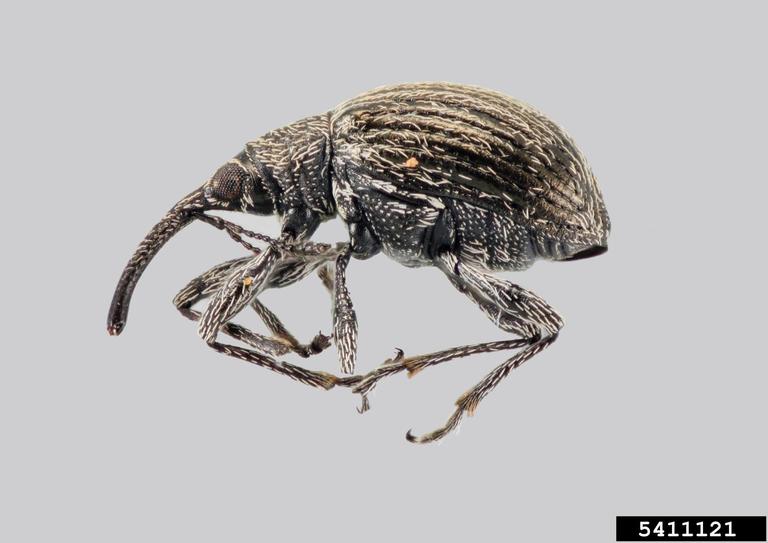
How to identify Curculionidae: Members of Curculionidae range in size from 1-40 mm, most being about 3-12 mm long. Their general appearance is difficult to describe because of their range in shapes and the fact that bark and ambrosia beetles (which are extremely different from typical weevils; right) are now included in the family based on traits like larval form and genetic similarities. Excluding bark beetles and pinhole borers, most weevils are often cylindrical, heavily armored and usually have an elongate snout (they are even referred to as snout beetles) with mouthparts at the tip. The best trait to identify typical weevils is their elongate, elbowed antennae that usually end in a small club. Like Chrysomelidae and Cerambycidae, typical weevils have an apparent 4-4-4 tarsal formula (actually 5-5-5), with a minute 4th segment. Bark and ambrosia beetles may have a small snout, but most have a normal-looking head. They are small, elongate, and cylidrical, with Scolytinae usually having their head hidden beneath their pronotum, and blunt, often spiny, tips of their elytra. Platypodinae have more elongate tarsi that reveal all 5 segments (5-5-5), while those in Scolytinae have extremely small, compact, apparently 4-4-4 tarsi. Both of these groups also have antennae that are elbowed, but they are much shorter and end in a large, 1-segmented (Platypodinae) or 1-3-segmented club (Scolytinae). Larvae are grub-like and legless [21].
Links & References:
Weevils and bark beetles on Buguide
OTHER WEEVIL FAMILIES:
Brentidae: straight-snouted and pear-shaped weevils - [22] This family of weevils (including the former family Apionidae) is highly diverse. As larvae all feed on living or recently dead plants/trees (including some fungi that also decay the plants). The most common pests in this family include the oak timber worm (Arrhenodes minutus), sweet potato weevil (Cylas formicarius), hollyhock weevil (Rhopalapion longirostre), and the pine gall weevil (Podapion gallicola). Some are biological control agents of weeds. Like Curculionidae, members of this family have an elongate snout (rostrum). However, unlike Curculionidae they lack elbowed antennae (except for a few rare species). The straight-snouted weevils (Brentinae) are elongate and usually have a straight snout. Pear-shaped weevils (Apionidae), on the other hand, are fat with a thin head, thus the common name. They are also easily recognized by their cylindrical trochanters. Members of this family come in many different colors and textures, and males and females may differ in shape.

Attelabidae: leaf-rolling weevils - [23] This family is similar in appearance to other small, stout weevils with straight antennae (especially Apioninae; above) but often have very broad, rounded shoulders. As their name implies, many roll leaves, which they do by cutting and folding a fresh leaf into a barrel shape. There an egg is laid and the larvae feed on the leaf roll. Other weevils in this family will consume dead leaves, flower heads, and buds that are killed by the weevils cutting them with their mandibles. One famous pest in this family is the rose curculio (Merhynchites bicolor).
Other beetle pages:
Coleoptera: Introduction
Coleoptera Families 1: scarabs, jewel beetles, click beetles, and relatives
Coleoptera Families 2: powder-post beetles, sap beetles, ladybugs, and relatives


